Email Warmup for New Emails
A new domain or a new mailbox has no sending history, and mailbox providers treat sudden volume from an unknown sender with suspicion. Warmup builds that history before customers start receiving mail from it.
About to send campaigns from a new domain? Email warmup services for businesses about to send at volume from a new domain or mailbox, such as a newsletter launch, a new online store or a move to a new sending platform. Volume rises in planned stages, so Gmail and Outlook learn to trust the domain before customers start receiving mail from it.
Warmup is built for mail to people who expect it: customers, members and subscribers who opted in to hear from the business.
Say which domain will send, what kind of mail it is and roughly how many messages a day are planned.
A written quote comes back by email, with the scope and the price set out before any work starts.
Prefer to talk it through? Book a call.
A new domain or a new mailbox has no sending history, and mailbox providers treat sudden volume from an unknown sender with suspicion. Warmup builds that history before customers start receiving mail from it.
An established address that has only ever sent everyday mail still needs warming before its daily volume rises, because mailbox providers judge any sudden change against the history they already hold. Volume is raised in stages rather than all at once.
A burnt domain has lost its reputation, usually through spam complaints, bounces from an old list or a sudden burst of volume, so its mail lands in spam even when authentication passes. Once the cause is fixed, a slow ramp to the most engaged contacts rebuilds trust with Gmail and Microsoft. Where the damage runs too deep, the weekly report says so, and a fresh sending domain is the better route.
A domain or server on a blocklist such as Spamhaus has to be delisted before warmup can help, because mail sent while listed is blocked outright. The listing is traced to its cause and removal is requested, then warmup rebuilds volume without triggering a new listing.
Mailbox subscriptions, contact lists and campaign writing are not part of warmup. Setting up the campaigns themselves is covered by email marketing services.
A manual warmup is possible for small volumes:
There are four ways to prepare a domain for sending at volume:
| Option | What it involves | Best for |
|---|---|---|
| Skip warmup | Send to the full list straight away and risk the first campaigns landing in spam | Very small lists |
| Warm up manually | Small batches to engaged contacts, raised by hand over several weeks | Patient senders with small lists |
| Use a warmup tool alone | An automated network sends and opens mail, but nobody reads the placement results or adjusts the ramp | Senders who monitor it themselves |
| Managed warmup | Authentication fixed, ramp sized to real plans, monitoring and weekly reports | Businesses launching campaigns on a deadline |
Email warmup services are quoted per job, because the length and size of the ramp depend on the plans. The price is set by:
The quote sets out the scope and the price in writing before any work starts, and nothing is charged without it.
Email warmup is the gradual increase of sending volume from a new domain or mailbox, so mailbox providers see a steady, well-received sender instead of a sudden burst of mail from an unknown one. A new domain has no reputation to rely on, and sending a full campaign in its first week looks like spam.
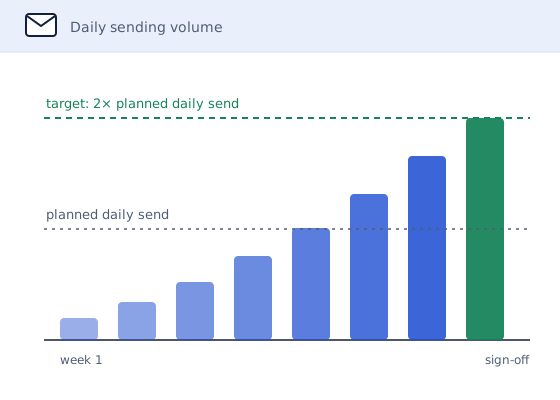
Email warmup usually takes around four weeks, depending on the target volume. The plan in the quote sets the schedule, and higher volumes take longer. Sending volume rises in stages, and each stage is checked for bounces and spam complaints before the next one starts.
Warmup is not needed for every new email domain. Everyday person-to-person email builds reputation on its own. Warmup matters when a domain is about to send newsletters, offers or notifications to a whole list, because that is the kind of sudden volume that mailbox providers treat with suspicion from a new sender.
Only after the cause is fixed. Warming a domain that fails authentication or sits on a blocklist does not help, because providers keep filtering the mail for the same reason. An email audit or deliverability fix comes first, and warmup follows once the domain passes its checks.